





























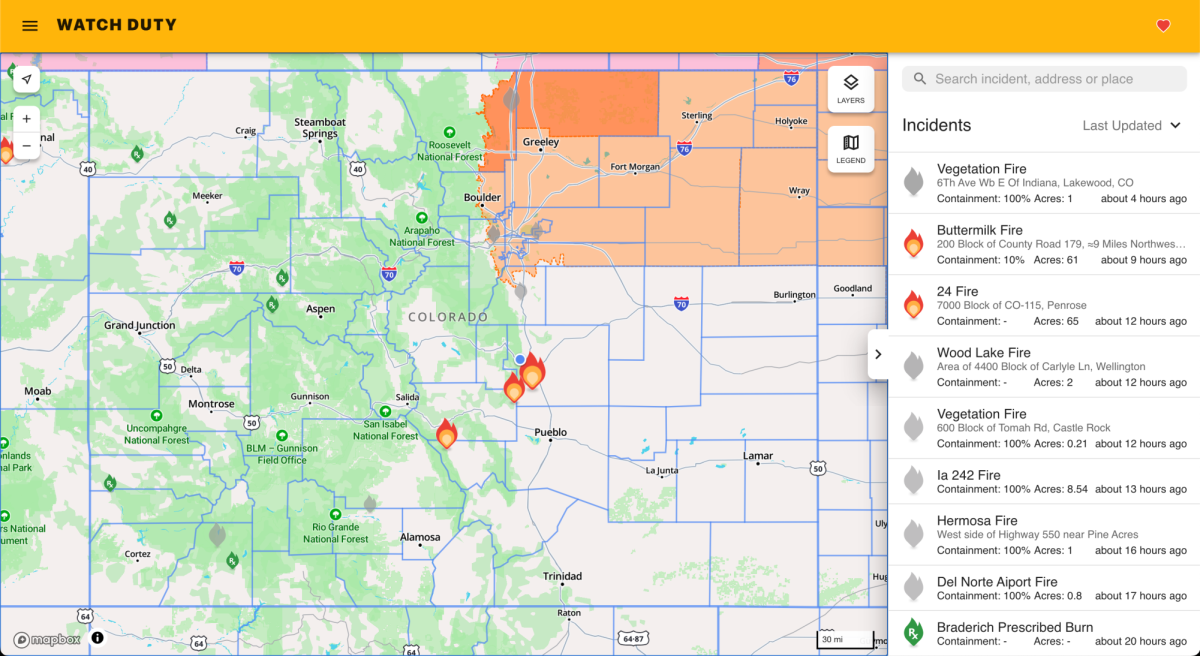
Spring has barely started in Colorado and the state has already experienced several wildland fires. A dry winter with minimal snow in most areas as well as high winds create the perfect conditions for a wildfire. This has already caused several small and large fires across the state and country. You can look at current and past fires in the area via Watch Duty, an app or website that tracks fires across the country.
Riley Finney is a senior firefighter for the state of Colorado with the TAVA Module. The TAVA Module can deploy to anywhere in Colorado as a team themselves or team up with another state module to create a full type 2 ICS team. Whether they are alone or with another module their primary function is fire suppression through digging control lines they employ other tactics as well but control lines are their specialties. Finney believes that the outlook for this fire season does not look good. “My biggest concerns are we have not gotten a lot of moisture so far this winter. I don’t know how it falls, as far as records go, but I was born and raised in Colorado Springs, and so I don’t remember ever being this warm, this consistently through the entire season,” Finny said. “I’m a little bit concerned. When we see windy, hot and dry conditions most of those things do not add up to make positive conditions.”
However, Finney is also hopeful that the season could take a positive turn away from these current conditions. “We could still get monsoons at least in the summertime,” Finney said. “We could get more snowfall kind of later in March and April. Colorado has a really good way of balancing itself. So we’re hoping for some moisture to make it less dangerous.”
Karen Bodine, the fire chief of Cascade Volunteer Fire Department believes that fire seasons in Colorado are always a concern but especially this year. “It’s always a concern but more especially as we have a significant decrease in moisture in the area and the change in weather with high winds,” Bodine said. “Our area is overgrown and populated with dense overgrowth of trees and shrubs.”
The most important thing you can do to prepare yourself for this upcoming fire season is to have a plan to evacuate and make sure your whole family knows that plan and what to do. Colorado Springs Fire Department has a great resource available on their site COS Ready, especially their 3 step be ready plan. Step 1 is to get notified you can do this via Peak Alerts this will notify you of evacuation orders. Step 2 is know your zone you can do this through the Genasys Protect. This will show you what your evacuation zone is. Step 3 is to get the Ready Set Go tool kit that will show you what to do to be ready to leave during an evacuation event.
Finney believes that the most important part is to be informed on the plan for your area to prevent a larger problem. “The pre plan is so important, just so that you have an idea on what you’re supposed to be doing in an evacuation. If you can imagine, in an area where everybody in your neighborhood decides to get up and leave at the exact same time, depending on where you live, that might not be a big deal, but in some areas, that’s a huge deal,” Finney said. “You have 300 people in a suburban neighborhood all in their three separate cars trying to drive down the same road. You’re going to have a crazy traffic jam. And on top of that, you have responders coming in at the same time. So learn what your routes are. Learn how it’s going to function.”
Finney says that responders will prioritize the safety of people over fighting the fire if needed so it’s important for communities to keep informed so the process is refined and goes along smoothly. “If we are trying to juggle both of those things at the same time, we’re going to prioritize your safety first, and maybe that fire is going to take the back burner for that period of time. That’s just something to be aware of. The smoother you can make it, the better, and the more people that know that, the better,” Finney said.
Bodine thinks that a combination of being more aware and mitigating your area is the best way to prepare yourself for this upcoming fire season. “Mitigation efforts from the homeowners and property owners of their properties are a huge key to the success of protecting property in the area,” Bodine said. “Also, a heightened awareness for the need to be prepared in the event of a fire with proper evacuation procedures and kits ready to go to leave their homes for extended periods of time.”
In the area of Manitou Springs and the Ute Pass, we have a greater risk factor because we live in a wild land urban interface (WUI) as defined by the U.S. Fire Administration as The zone of transition between unoccupied land and human development. It is the line, area or zone where structures and other human development meet or intermingle with undeveloped wildland or vegetative fuels. You can read more about the WUI on their website. This presents a hazard for all who may live in that zone. This is due to the speed in which a major fire can make a run towards a residential area or business so you have much less time to get ready and go. You can learn more about your specific risk on a map the Manitou Springs Fire Department has put out and how you can reduce your personal risk.
Bodine believes that the entire Ute Pass corridor is at the most risk in our community. “The West side of Cascade is an extreme area for fire danger. The East side did burn during the Waldo Canyon fire in 2012, but has already regrown and is still a significant threat as well. The area between Manitou and Cascade is a funnel of heavy loaded fuels that will also be wind driven from the natural flow of wind,” Bodine said. “The Cascade area is heavily populated with homes and structures that do not allow for proper mitigation requirements around a lot of properties due to terrain and access, so the risk is significant for the entire Ute Pass area.”
Bodine strongly believes that preparedness to leave for extended periods is the most important thing to remember for this upcoming fire season. “Preparation is critical. In the event of an evacuation, the ability to leave as quickly or rapidly as possible is the most important key. Residents must understand that they may be away for a very long extended period of time, so to take all the proper necessities such as medications, medical care needs, important documents and immediate supplies like chargers, phones, portable devices for contacting family or friends,” Bodine said. “The most important thing to do is to leave when asked and as quickly or fast as requested.”