
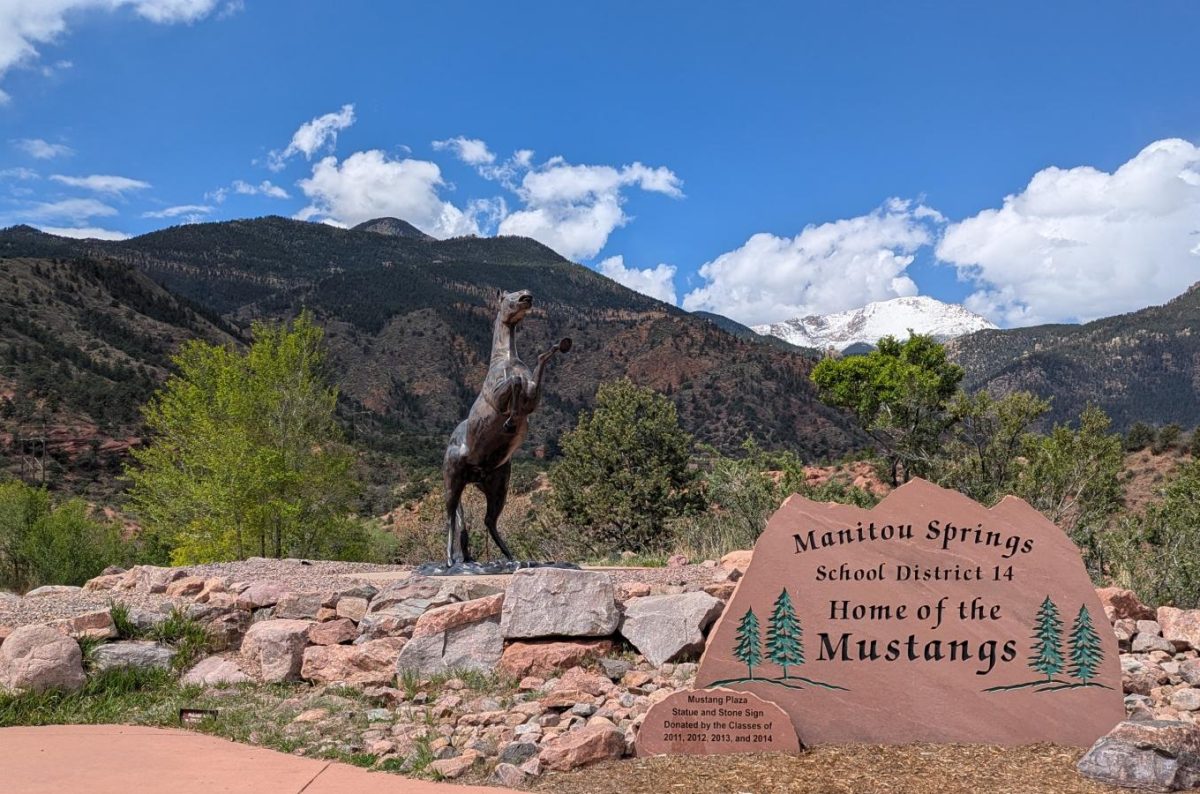


































On Nov. 7 2025, Manitou Springs High School went into a lockout due to a mountain lion being found near the path between both MSHS and Manitou Springs Middle School. The lockout lasted from second block all the way to almost the end of the third block lasting almost two hours total. Despite the threat these animals may cause to people, mountain lions are a vital and key puzzle piece to Colorado’s environment.
Mountain lions are also known as Puma concolor, cougars, pumas, panthers, wildcats, catamounts, painters and so many other names. These cats are actually more closely related to felids rather than pantherids. This is due to a difference in the hyoid bone that determines if a cat either roars or meows and purrs or chuffs.
The Mountain lion’s closest living relative is the Jagurundi, Herpailurus yagouaroundi, a small cat native to South America. Adult male Mountain lions can be around 8ft long, tip to tail, and weigh as much as 150lbs while females, although smaller, can be up to 7ft long, tip to tail, and weigh up to 90lbs. Depending on sex, mountain lions can maintain a territory of around 100 miles and can be found as far south as Patagonia to as far north as very southern Alaska but have unfortunately been extirpated from the majority of the midwest and almost the entire east coast except for small populations in North South Dakota, Nebraska eastern Montana & Wyoming and south west Florida.
Mountain lions prefer rocky canyons and mountainous terrain but can really be found anywhere any species of new world deer can be found, including suburbs. Mountain lions regularly hunt various species of deer but can also hunt Elk, Moose Bighorn Sheep Rabbits Rodents Raccoons Coyotes Porcupines Squirrels Marmots Skunks Feral Hogs and on occasion unattended farm animals and pets. Mountain lions also compete with wolves and bears for both shared prey species, territory and possible denning areas due to how valuable these resources are to everyone of these predators.
Despite how some might find these wild cats to be vicious beasts, Mountain lions actually prefer to stay away from humans as much as possible due to their solitary nature. Mountain Lions also kill less than 1% of livestock and pets per year and less than one person a year are killed by Mountain lions which is even less than annual lightning strike deaths (which is 28 people per year). However, the majority of Mountain lion attacks are primarily children and teens due to their small stature which can trigger a predatory instinct in the animal but attacks on adults still can occur.
Mountain lions are ambush hunters and surprisingly very well hidden in their surrounding environment. Mountain lions can see around 200ft (62m) and hear almost a mile (1.6km) away although this cat’s sense of smell is actually not that great compared to other felids. Despite this though, if you actually see a Mountain lion either you are super lucky or the cat intended for you to see it.
Even though Mountain lions tend to stay away from humans, they are still considered a possible threat if seen near or around places like school putting them in lockout in order to prioritize children’s safety. However, this is and the idea of these animals hunting our livestock is not an acceptable or even intelligent reason to exterminate them from our surrounding ecosystem. Mountain lions are a keystone species meaning that their removal from the environment will have catastrophic consequences. If you seek to aid in
Mountain lion conservation, you can donate to State/National Parks or specialized organizations that actively work in the field with mountain lion conservation. You can also visit your local zoo which also aids in the conservation of many different species.
Though remember these are potentially dangerous animals so if you see one in the wild, admire from a safe distance (at least 50 yards) and if the cat is extremely close to you and showing threat displays, find a or use a weapon like a stick, rock or an actual weapon, stand your ground and do not run away. Maintain eye contact and make yourself as big as possible by swinging your arms around, flipping the back of your jacket behind your head or gathering in a group of people. If you are actively being attacked, use everything you have at your disposal to fight back and aim for the neck but whatever you do don’t play dead.
So admire these amazing creatures and their importance in the wild if seen out in nature, but keep in mind these are possibly dangerous animals that demand respect and distance.